The Great Pivot: Romania’s €90M Bet on a Post-Outsourcing Future
.png)
For a decade, the narrative of the Romanian tech scene was one of "time-renting": a high-density pool of developers serving as the back-engine for Western giants. But as we move through 2026, the "Bucharest Bubble" is giving way to a more distributed, sophisticated economic engine.
Investors are calling it the "Correction Spring." It marks the moment Romania transitions from a source of low-cost code to a hub for high-margin, "Deep Tech" products.
With nearly €90 million in regional venture capital now deployed specifically outside the capital, the focus has shifted from ephemeral consumer apps to the hard, tangible problems of the continent: energy, hardware, and data sovereignty.
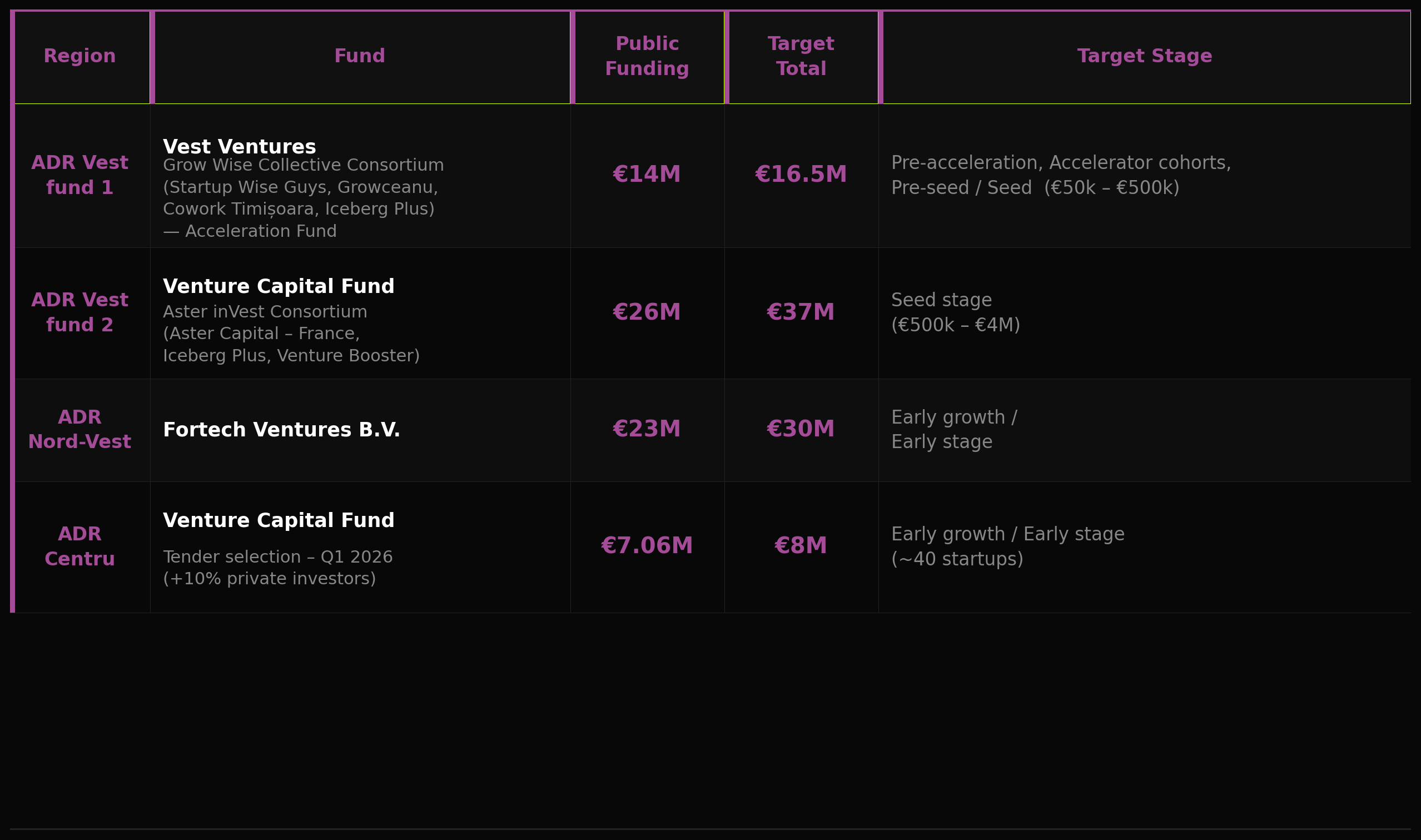
The regional capital shift: 2026 Funding Map
The decentralization of capital is being driven by the Regional Development Agencies (ADRs), which have moved aggressively to anchor innovation in the West, North-West, and Central regions.
From software to "hard" innovation
The shift in Romanian capital allocation reflects a broader European pivot toward Industrial Sovereignty. Three key trends are currently redefining the continent's investment thesis:
- The shift to "real" tech: Investors are moving away from basic AI and simple apps. The new focus is on "tangible" innovation, things you can touch, like Advanced Manufacturing (new materials), Energy, AgriTech, and Healthcare hardware.
- The "secure stack" (Data Sovereignty): Europe is breaking its dependence on foreign clouds. Started with France’s lead (where public administration has begun a "calculated divorce" from American platforms like Microsoft Teams and Zoom), followed by Sweden’s approach; there is a massive push to keep data local. As the saying goes: "If you don’t hold the keys, you don’t own the house." France has already turned this into an economic engine, attracting billions in data center and AI investments.
- The Circular Economy: As consumer fatigue hits the gadget market, the circular economy is becoming a venture-scale opportunity. The recent launch of the Dutch Fairphone 6 (€549), designed for a ten-year lifecycle and 100% repairability, has provided a blueprint. Even established Romanian players, such as Meze Audio, are targeting this "forever hardware" niche, betting that durability will soon outvalue planned obsolescence.
The "Deep Forest" Refinery: From Feldioara to the Stars
The most striking evidence of this shift is located in the dense forests of Feldioara, Brașov. Here, the FPCU (Nuclearelectrica) facility is being repurposed into a strategic refinery for rare earth elements.
Through a signed partnership with Critical Metals Corp (Nasdaq: CRML), the site will process minerals from Greenland’s Tanbreez deposit, a project valued at $3 billion. This facility represents a direct challenge to China’s monopoly on materials critical to defense and green energy.
The SpaceX connection: Minister of Energy Bogdan Ivan confirmed in February 2026 that high-purity materials refined at Feldioara are destined for the aerospace sector, including Elon Musk’s SpaceX, for use in satellite production and ion thrusters.
Geopolitical resilience: By establishing refining capacity within the EU, Romania is directly challenging China’s monopoly on materials critical to defense and green energy.
3 sectors to keep an eye on:
- Procurement: TenderingOS startup, emerging from stealth, this AI-driven platform by Adrian Niculescu and Laurențiu Clenci is automating the complex procurement cycles that the new European industrial machine requires.
- Energy: A new wave of hardware-software hybrids is emerging to manage decentralized energy grids, moving Romania closer to a self-sustaining tech stack.
- Cybersecurity: As employees integrate Agentic AI into their daily workflows, sensitive intellectual property is being funneled into third-party chat windows (despite EU efforts to educate on data literacy), making secure, localized AI solutions a requirement.
The bottom line
In late 2025, ecosystem leaders like Ionuț Țața (CEO, Iceberg Plus) documented the early tremors of this funding surge. The "Bucharest bubble" has finally burst, and might be the best thing that could have happened to Romania in recent years. By moving to the regions and focusing on hard-to-build technology, Romania’s talent pool has the chance to build its own products.
As we approach this new beginning, the big question remains: Can Romania truly compete on innovation alone, moving from being a player in someone else’s game to writing the rules of the next one?