Citiverse
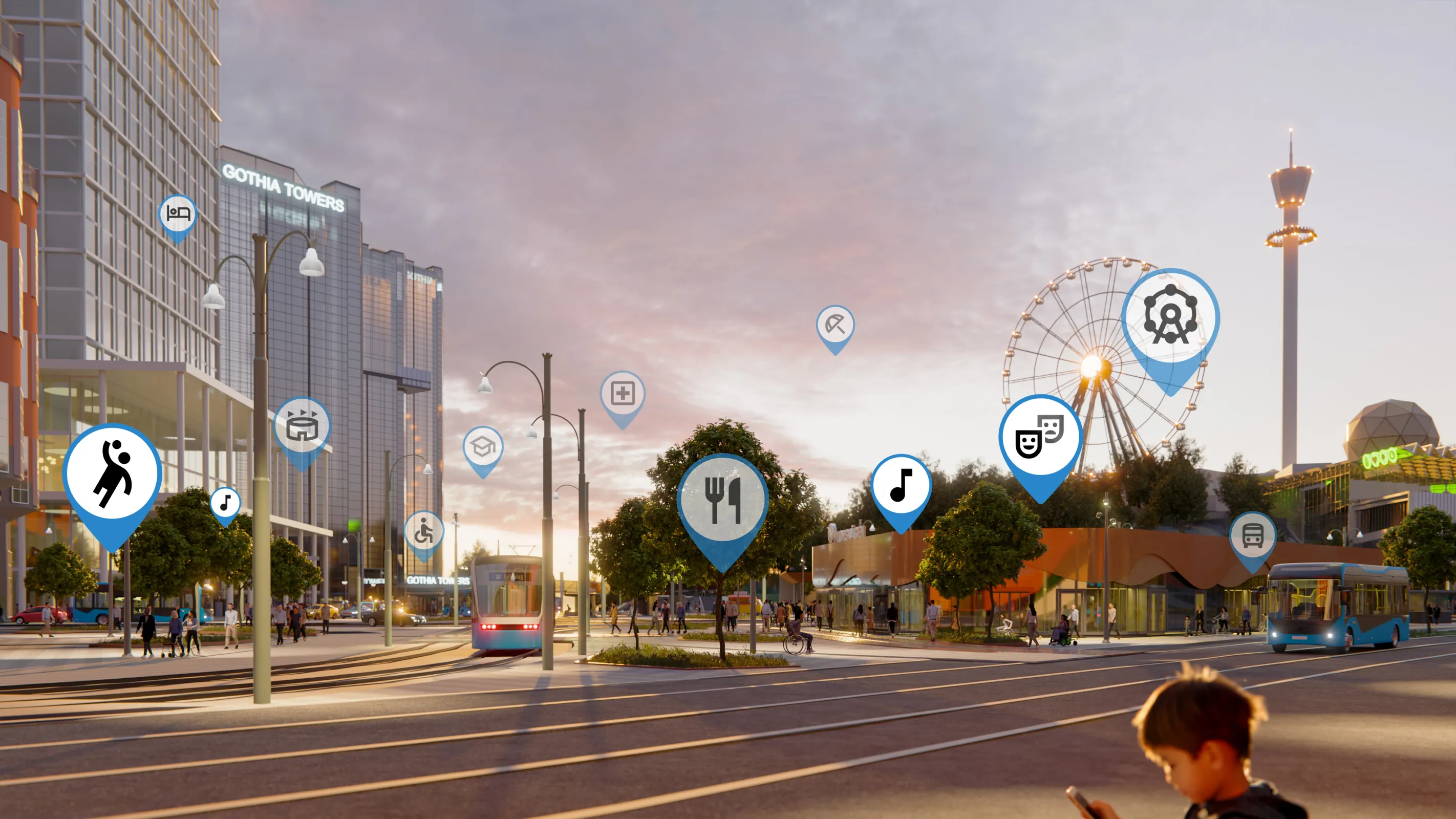
European Citiverses Uniting for Inclusiveness (2024–2026) - one of the four flagship projects co-funded by the European Union’s Digital Europe Programme.
Have you ever wished you could "preview" your day in the City?
For these citizens, city life remains unpredictable. Traditional smart city solutions often optimize traffic for cars but fail to provide a person in a wheelchair with the predictability needed to find a working elevator or navigate a sensory-friendly route.
Digital twins for urban environments have entered their second decade of focused research, transitioning from a conceptual idea in the early 2000s to a rapidly evolving practical tool in the 2020s. Research interest increased dramatically starting around 2017–2018, evolving from static 3D visualizations to dynamic, AI-integrated models capable of real-time simulation and prediction. As this field expands across varied domains like urban planning, environmental data, energy, and transportation, definitions frequently differ between organizations, ranging from simple 3D visualizations to autonomous systems requiring bidirectional, real-time data exchange.
The European Citiverses Uniting for Inclusiveness (CU) project mission is to strengthen inclusiveness and set up a scalable model for other cities using AI and Local Digital Twin technology
The Challenge
The key challenge the project seeks to address is twofold: first, to support the transition from a 3D map toward the much more ambitious standard implied by the “Citiverse” vision; and second, to ensure that this technological development is grounded in Universal Design principles and actively advances accessibility.
In response to these gaps, the European Citiverses Uniting for Inclusiveness (CU) project was launched to explore how accessibility can become a primary driver of urban innovation and to test this approach through a prototype developed in a real-life environment.
How do we contribute to the challenge?
The CU project operates through four development streams designed to support a "Digital Right to the City":
About the consortium
Co-funded by the EU’s Digital Europe Programme, the CU project brings together a specialized consortium of 12 partners with diverse expertize:
Sweden: The City of Gothenburg (project owner), Lindholmen Science Park (technical coordinator), Göteborg & Co, Our Normal Association, RISE Research Institutes of Sweden, Kokokaka and Virtuell Design
Finland: Younite AI
Romania: Iceberg Plus and The Point Labs
Bulgaria: GATE Institute
Bulgaria: GATE Institute
Netherlands: University of Twente
The following partners are associated with the project: Kungsbacka municipality, School of Business, Economics and Law at the University of Gothenburg, Region Västra Götaland, YRGO, Digital Twin Cities Centre at Chalmers University of Technology.
Third party partner: Nvidia
How does our Iceberg Plus team contribute?
Iceberg Plus, is leading the Business Development (Work Package 5) for the Citiverses Uniting for Inclusiveness (CU) project. Our job is to research how inclusive digital twins contribute to the cities of the future. We are focusing on four key goals:
Connect & Collaborate
Municipalities Innovation Department representatives | NGOs or Professionals focused on accessibility | Policy Makers | Business sector | Startup sector
Do you want to understand the business potential of municipal digital twins or how you can increase accessibility in your city?
Write to Loredana Gavrilescu, Business Development Lead, to start the conversation: loredana.gavrilescu@iceberg.plus
Looking ahead...
Looking toward 2027, the European Citiverses Uniting for Inclusiveness (CU) project is evolving from a localized pilot into a definitive continental blueprint for the next generation of urban life.
We are setting a new European standard where the digital twin solutions of tomorrow might be inclusive by design and accessible to all by default.
If you are curious to see the Citiverse in action
You can follow our progress, explore our latest research, and see how we are building a more inclusive Europe at our official project hub.
Check out the work


OUT
SMART THE MARKET
THINK THE STRATEGY
DO THE STATUS QUO
SMART THE MARKET
For startups, SMEs, academia, authorities.
For Bold ones.